← Research
01 — Core identity

Physical AI & Digital Twin for Manufacturing

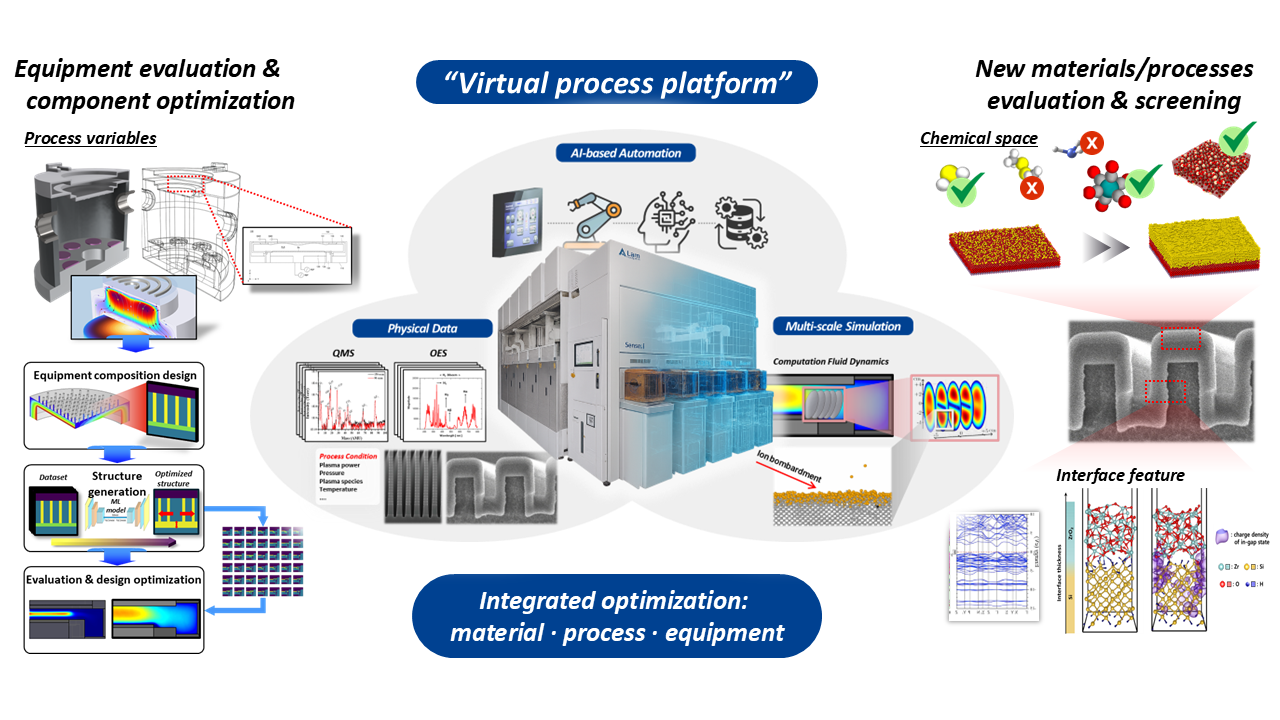
We build physics-informed virtual process platforms that combine simulation data with experimental databases. Bridging the virtual and physical worlds, our Physical AI and digital twins target real-time process evaluation, predictive process control, and interpretable decision-making for real semiconductor manufacturing, with ultra-precision cryogenic etching as the primary proving ground.

Physical AI & Digital Twin
// Focus areas

What we work on

01

Digital twin for semiconductor manufacturing

We build physics-informed digital twins that fuse simulation data with experimental databases to mirror the process in a virtual space. The goal is real-time evaluation, predictive process control, and interpretable decision-making for the fab floor. We are currently building this platform with ultra-precision cryogenic etching as the primary proving ground.

Digital twinExperimental DB
02

AI-based virtual-physical integration for etching

A physics-based framework couples ion-transport modeling with machine-learning surrogates to link the virtual process and the physical system. It lets us analyze energy delivery and surface interaction where direct measurement is hardest. Right now we apply it to high-aspect-ratio plasma etching.

Ion transportML surrogateCFD
03

Surrogate & reduced-order models

Deep neural networks compress expensive ion-surface interaction physics into reduced-order surrogates. This accelerates feature-scale process prediction by orders of magnitude without discarding the underlying mechanism. The surrogates are trained on molecular-dynamics data, as in our DNN reduced-order modeling work.

ROMDNNMD
04

AI sensor monitoring & explainable AI

In-situ OES and QMS signals feed CNN + MLP models that track the process as it runs. We predict etch rate and endpoint, and use explainable-AI attribution (SHAP) to tie predictions back to physical process knobs. This is demonstrated on plasma dielectric etching.

OES / QMSCNN + MLPSHAP
05

LLM & Agentic AI for process automation

We are extending the platform toward LLM- and agent-based automation of process workflows. The aim is to close the loop across the machine-AI-human interface, from decision to action. This connects the digital twin's predictions to executable process steps.

LLMAgents
// Methods & tools

How we work

AI & surrogates

Deep-neural-network surrogates / ROM

Explainable AI (SHAP)

Bayesian optimization

Sensor analytics

OES / QMS in-situ monitoring

CNN + MLP endpoint models

Reactor & multiphysics

CFD (Ansys Fluent / Chemkin)

DSMC feature-scale transport

Agentic AI

LLM / agent orchestration

// Representative publications All output →

Selected papers in this area

← All research Next: Multiscale Simulation →