← Research
02 — Foundational capability

Multiscale / Multiphysics Simulation

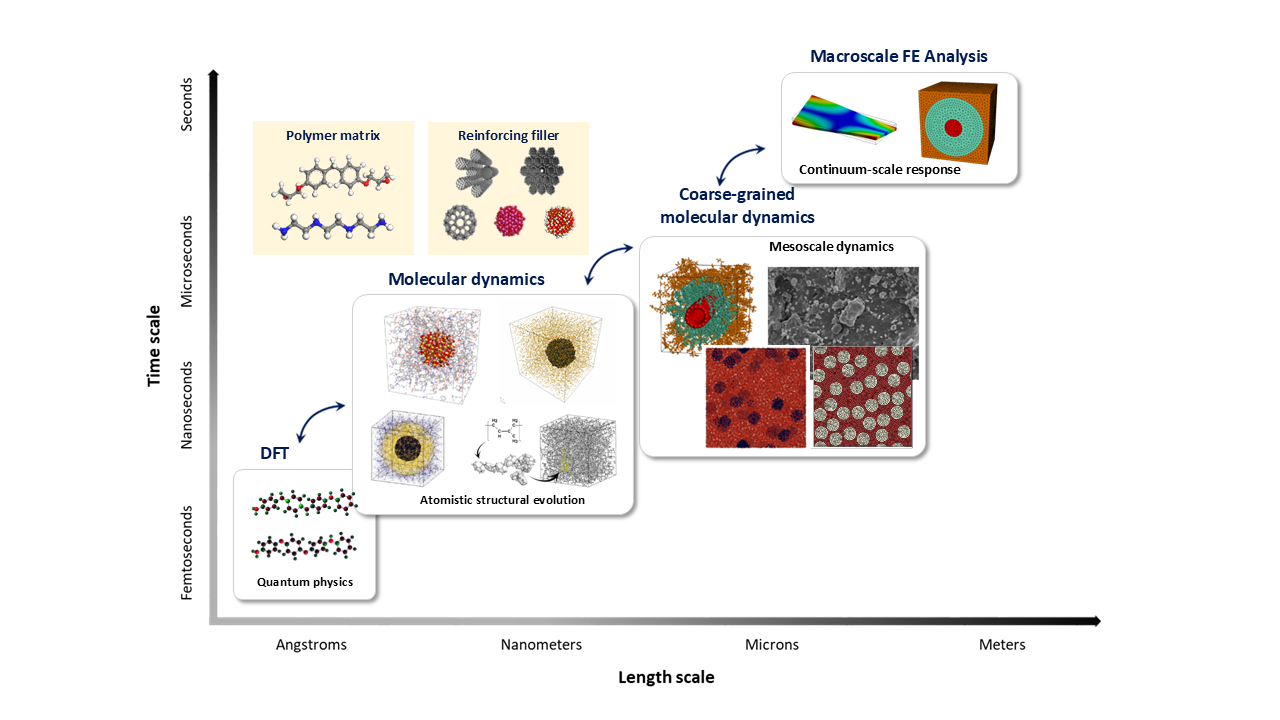
Using data-driven computational frameworks that bridge atomistic to continuum scales, we model complex engineering systems with coupled physical phenomena. We resolve plasma-surface interactions in semiconductor processing at the atomic level, combining machine-learning force fields (MLFF) with molecular dynamics to explore the theoretical limits of challenging processes.

Multiscale / Multiphysics Simulation
// Focus areas

What we work on

01

Quantum-to-continuum multiscale modeling

We bridge quantum, atomistic, continuum, and reactor scales in a single data-driven framework. This lets us model complex engineering systems where coupled physical phenomena cross length scales. It is the backbone that ties our atomistic insight to process- and reactor-scale behavior.

DFTMDDSMCCFD
02

Plasma-material interaction

We resolve plasma-surface interactions such as etching, plasma annealing, and sputtering at the atomic level. Currently we study the atomistic mechanism of low-temperature NF₃/H₂ etching of SiO₂-SiN-SiO₂ stacks, which underlies cryogenic selectivity, and ion-bombardment-driven crystallization with pressure-dependent radical transport (e.g. plasma-assisted crystallization of Al-doped TiO₂).

Reactive MDPlasma
03

Molecular dynamics & first-principles

Molecular dynamics (including reactive MD), DFT, and first-principles calculations are our core engines. We currently apply reactive MD to plasma-activated SiCN bonding and Cu-Cu diffusion bonding, quantifying bonding energy and interfacial void formation. These feed structural insight back into process design.

LAMMPSReaxFFVASPOVITO
04

Machine-learning force fields

Machine-learning force fields and neural-network potentials extend MD toward first-principles accuracy at scale. We train them for etching, deposition, and 2D-material systems where classical potentials fall short. This is what makes large, reactive simulations tractable.

MLFFSevenNet
05

Feature-scale & continuum modeling

At the largest scale we model feature-scale profile evolution with DSMC transport and level-set methods. This connects atomistic reaction data to the shapes that actually form on the wafer. It closes the multiscale ladder from atoms to features.

DSMCLevel-set
// Methods & tools

How we work

Molecular dynamics

LAMMPS

Reactive MD (ReaxFF)

OVITO analysis

First-principles

DFT (VASP)

Ab-initio MD

ML potentials

MLFF / neural-network potentials (SevenNet)

Continuum & feature-scale

Plasma / DSMC transport

Level-set profile evolution

// Representative publications All output →

Selected papers in this area

← Physical AI & Digital Twin Next: Materials & Process →